
 All panels9 panel types
 Today’s pricesBNAL list, per sq m
 By application7 uses
 CalculatorArea, count, BOQ
 Thickness guideU-values
 Unit converterft ↔ m, sq ft ↔ m²
 BrandsCompare in one quote
 Dispatch cities20 cities
 GuidesPrice, thickness, PIR
What are the standard specifications of a PUF panel?
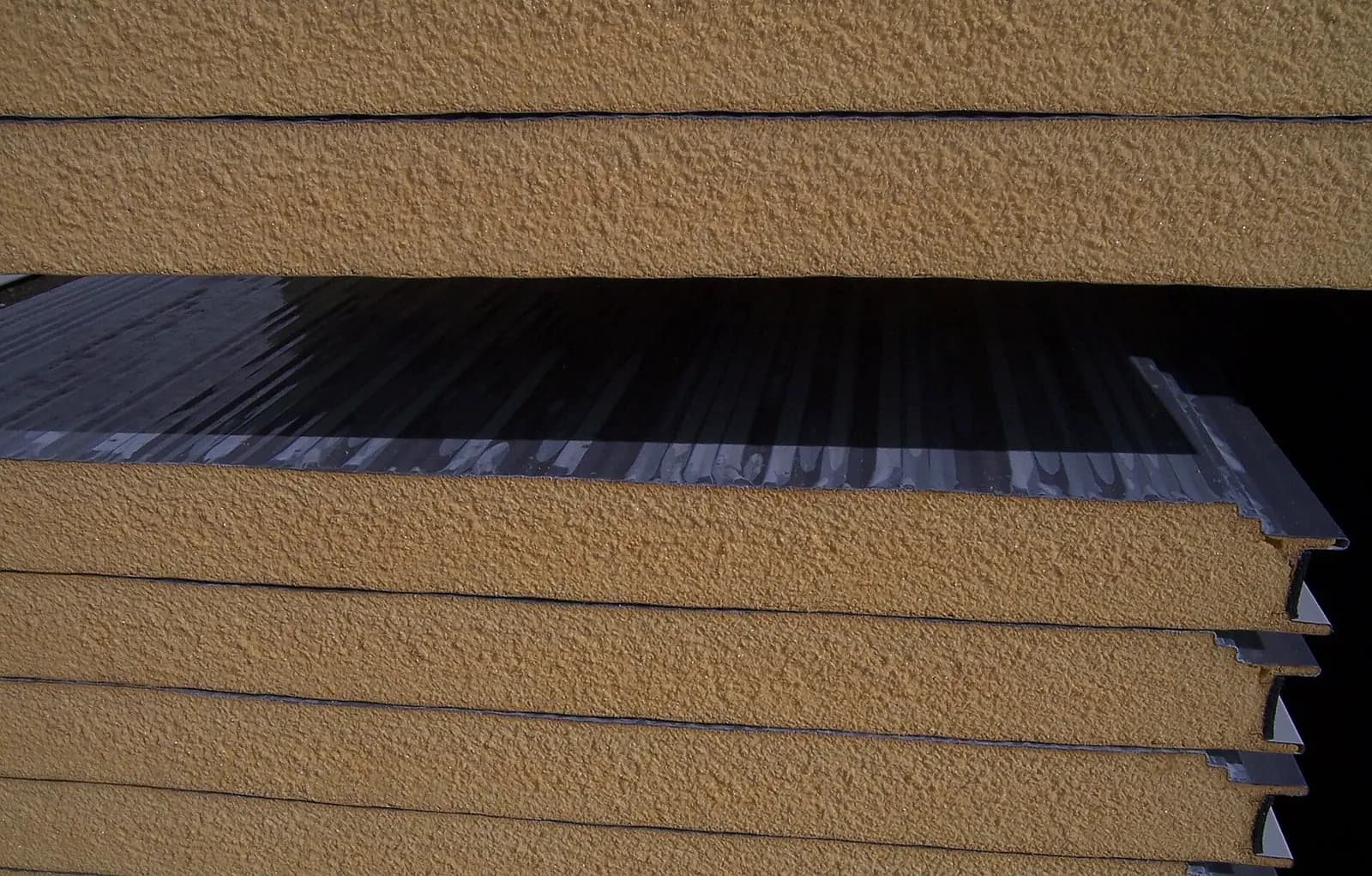
Typical PUF sandwich panels in India are 30–200 mm thick, about 1000 mm cover width (1000–1200 mm by maker and profile), cut to length up to about 12 m, with a 38–42 kg/m³ foam core and coated steel skins of 0.3–0.8 mm per face. A 100 mm core gives a U-value of about 0.21 W/m²K.
- Thickness
- 30–200 mm (typical)
- Cover width
- ≈ 1000 mm (1000–1200 mm)
- Core density
- 38–42 kg/m³ (typical)
- U at 100 mm
- ≈ 0.21 W/m²K
What sizes do PUF panels come in?
| Dimension | Typical range | Notes |
|---|---|---|
| Thickness, roof panels | 30–100 mm | Measured to the core; trapezoidal ribs on top |
| Thickness, wall panels | 40–150 mm | Flat or micro-rib faces |
| Thickness, cold-room panels | 60–200 mm | Cam-lock joints; thick cores for freezers |
| Cover width | ≈ 1000 mm | 1000–1200 mm by maker; cam-lock panels are often narrower |
| Length | Cut to size, up to about 12 m | Longer cuts need a long trailer and careful handling |
Panels are sold by area: cover width × cut length, added up for the whole order. That is why quotes are per square metre (or per square foot) rather than per panel. The panel calculator turns a room size into an area and a panel count.
The thickness you choose also changes the outside size of a room: panels add their thickness on every side, so a cold room built with 100 mm panels is 200 mm longer and wider outside than inside. Say which size you are giving when you ask for a quote. Lengths are normally cut to the drawing, with a small allowance for wastage on cut-outs and corners.
What is inside: core type and density
The core is rigid polyurethane foam (PUF), a closed-cell foam made from a polyol and an isocyanate. Typical core density for Indian sandwich panels is 38–42 kg/m³, often written as 40 ± 2 kg/m³. Some listings show lower densities; ask for the figure in writing, because density affects strength and long-term performance.
PIR (polyisocyanurate) is a related foam with better fire behaviour and about the same insulation; FR-PUF is PUF with fire-retardant additives. Both are named on the quote when supplied. See PUF vs PIR.
Fresh foam insulates slightly better than aged foam because blowing gas slowly diffuses out of the cells; datasheets usually state an aged or declared value. The steel skins on both faces slow this down a lot.
- Thermal conductivity (k)
- How easily heat passes through the material itself. For an aged PUF or PIR core it is typically about 0.022 W/m·K. EPS is about 0.035–0.038 and rockwool about 0.040–0.045, so PUF insulates the same with less thickness.
Which steel sheet and coating?
| Item | Common options | What to check |
|---|---|---|
| Sheet thickness | 0.3–0.8 mm per face | Both faces quoted, and at the same gauge if you need it |
| Base metal | PPGI (galvanised), PPGL (galvalume) | PPGL usually costs more and resists corrosion better |
| Special skins | Stainless steel 304, aluminium | For food, pharma, coastal or corrosive sites |
| Colour | Off-white (RAL 9002) is common | Special colours can need a minimum coil order |
What U-value does each thickness give?
| Core thickness | U-value (W/m²K) | Typical use |
|---|---|---|
| 30 mm | ≈ 0.65 | Shed roofs |
| 50 mm | ≈ 0.41 | Sheds, cabins, site offices |
| 80 mm | ≈ 0.26 | Ripening and mushroom rooms, chillers |
| 100 mm | ≈ 0.21 | Chillers |
| 150 mm | ≈ 0.143 | Freezers |
| 200 mm | ≈ 0.108 | Blast freezers |
For the thickness each room needs, see thickness by temperature. Rooms below 0 °C also need an insulated floor.
Joints, profiles and standards
- Continuous wall panels: tongue and groove or hidden-fix joints, screwed to a steel frame.
- Continuous roof panels: trapezoidal ribs on top with an overlapping side rib that sheds rain.
- Cam-lock panels: lock hooks foamed into the edges, pulled tight with a hex key; used for cold rooms. See continuous vs cam-lock.
In India, preformed rigid PUR and PIR foams are covered by IS 12436, and IS 661 is the code of practice for thermal insulation of cold storages. Sandwich panels themselves are often described against EN 14509. Ask the maker for the datasheet and any test certificates for the exact panel you buy.
Transport extraFlashing as per your requirement